Loading

“Wherever the art of medicine is loved, there is also a love of humanity.” — Hippocrates
“Wherever the art of medicine is loved, there is also a love of humanity.” — Hippocrates
Quick answers, Socratic conversations, visual diagrams, voice loops. One tutor that shifts to fit the way you learn, the subject you are studying, and the time you have.
Switch between modes at any point. The Tutor holds the thread.
Ask. Get the answer.
A clear, referenced explanation in plain language. Good for ward rounds, late-night revision, or any moment when you just need to know something properly.
Think your way to it.
The Tutor asks instead of tells. You do the reasoning, it follows where you go, and corrects you honestly when you drift. Slower, but it actually stays with you.
Draw it out.
Some things only make sense as a picture. Ask for a pathophysiology cascade, an anatomical relationship, a clinical decision tree. The Tutor draws it out and cites the sources.
Explain it. Find the gaps.
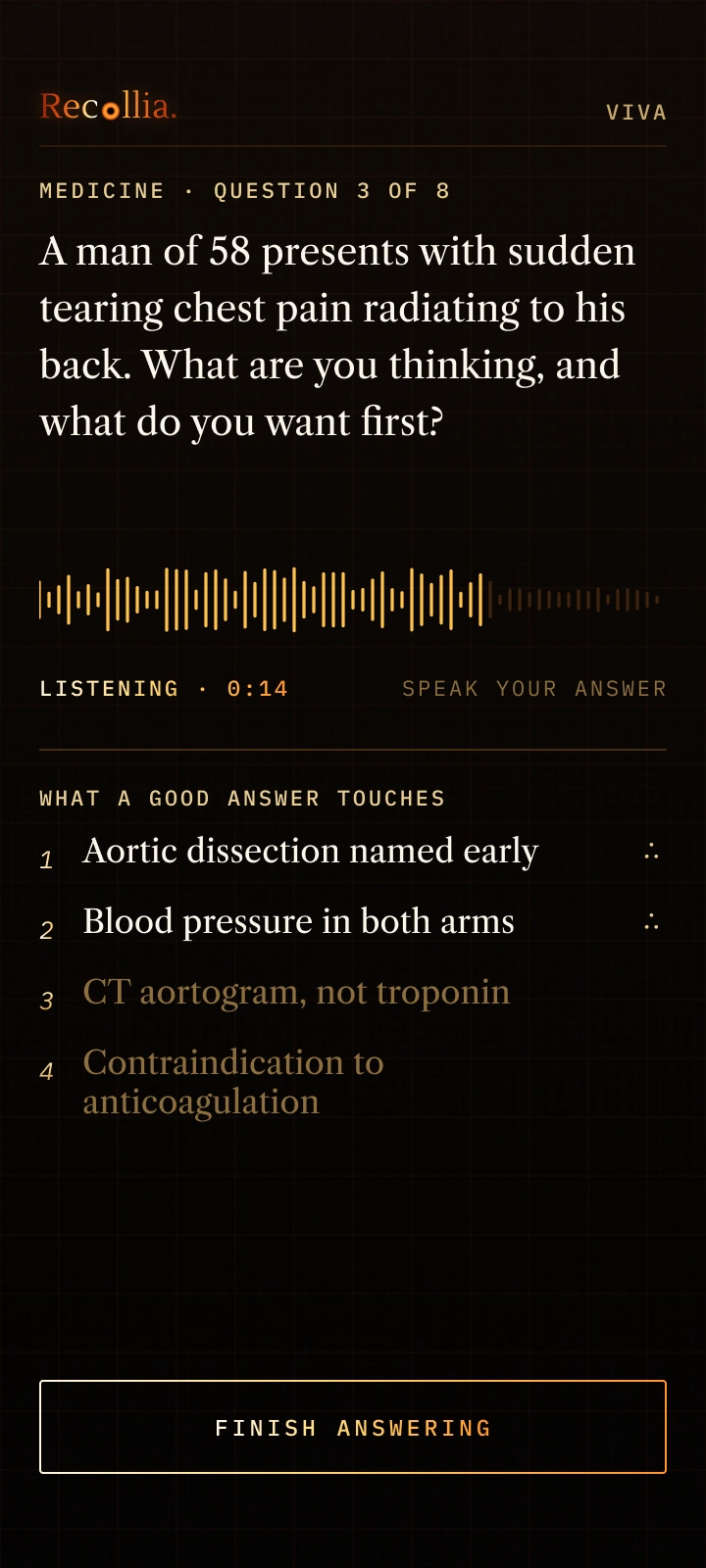
Speak through a concept in plain language, as if teaching someone with no background. Viva listens, catches every stumble and jargon fall-back, and corrects you against the clinical sources.
The Tutor does not hand you the explanation. It asks what you already know, follows your reasoning, and guides you to the right place. It is harder. It works better.
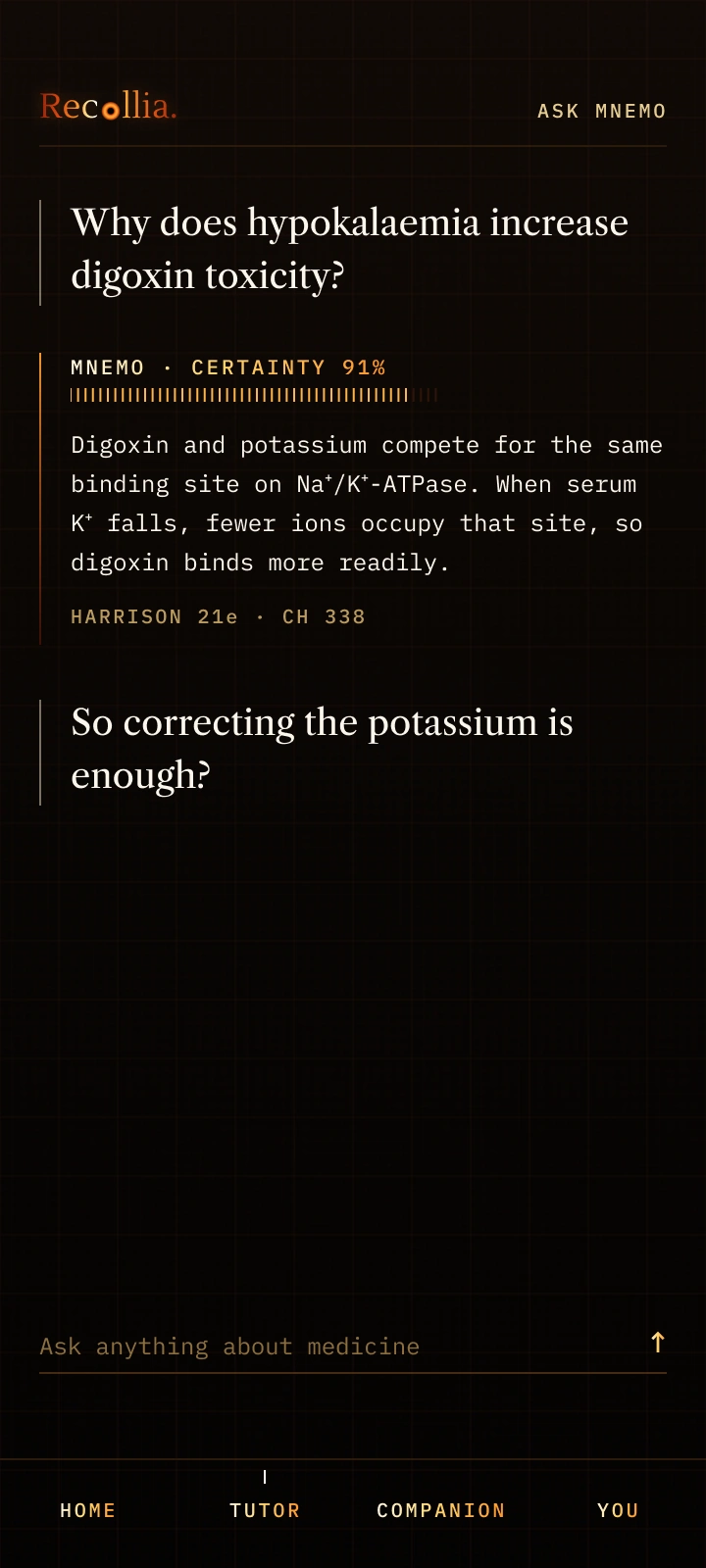
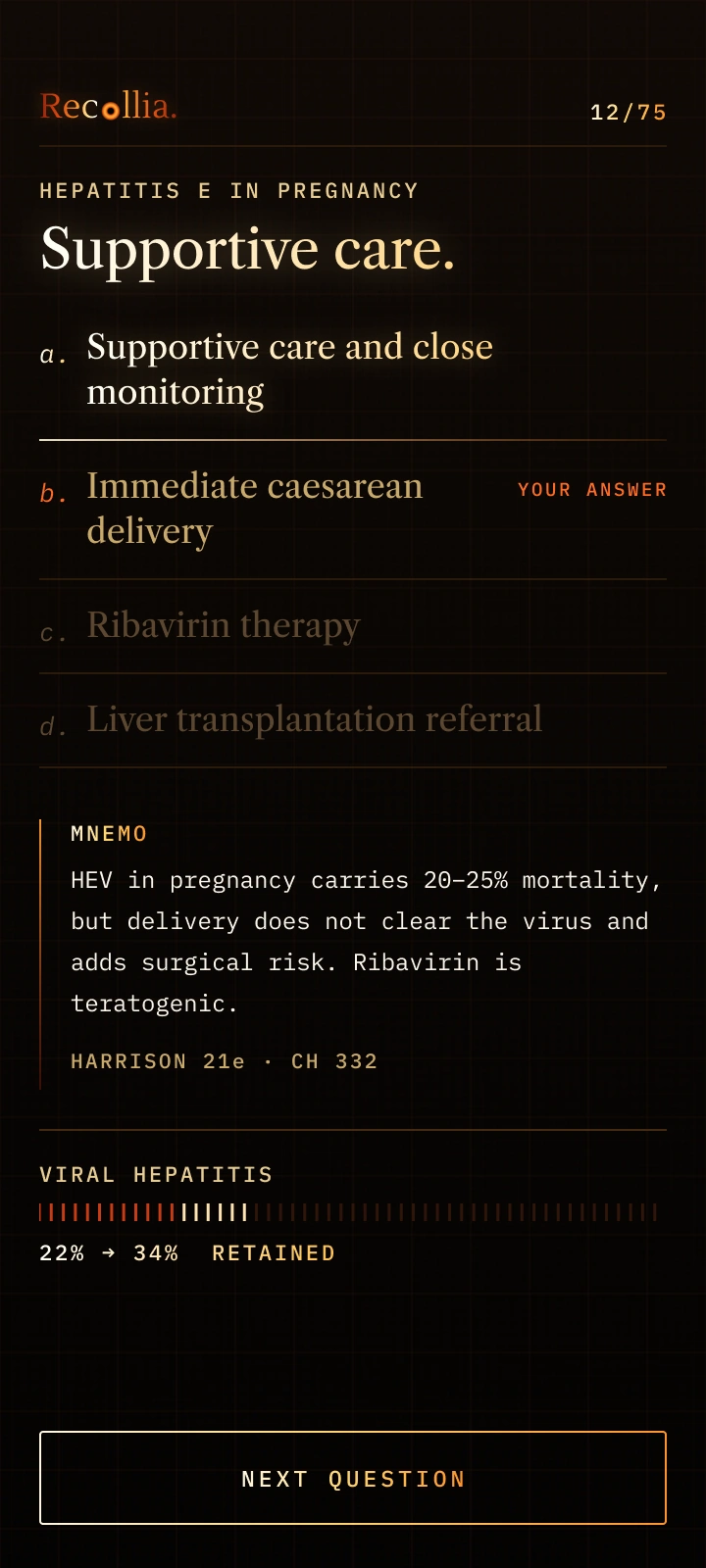
On a ward round, at midnight before an exam, mid-shift. Quick mode gets you a clear, referenced answer without setup. Ask, read, move on.
If you cannot explain it simply, you do not really understand it. Speak through a concept as if teaching someone with no background. Viva listens, catches every stumble and jargon fall-back, and corrects you against the RAG ground truth. The gaps in your explanation are a map of exactly where to go back.
Most study tools give the same answer to everyone. The Tutor adjusts to your level and remembers where you have struggled before.
A concept from a lecture, a question you got wrong, something a senior said that did not land. There is no wrong place to start.
The Tutor reads your level from how you ask and how you respond. A first-year gets different depth than a resident preparing finals.
Start in Quick, go Socratic when you want to think it through, pull up a Diagram when the words are not enough. All in the same conversation.
Recollia notes what you struggle with across sessions. Before an exam, those topics come back. Not everything. Just what you actually need.
First-year basics to final-year clinical. The Tutor covers the breadth of medicine and adjusts depth as you go.
No setup. Ask your first question and see how it teaches.